Showing posts with label posture. Show all posts

Monday, 17 January 2011

How better posture improves concentration

What your posture has to do with your ability to concentrate may not be immediately obvious, but if you have a sedentary job, you may want to consider how you sit when you work.

You may also want to think about sitting on an exercise ball, or add a wobble cushion to your chair, while you work. Experts think that the micro-movements your body needs to make to adjust will do more than just improve your core muscles and posture, it can also make you concentrate better.

Why?

When you sit on an exercise ball, you are constantly making tiny, subconscious physical movements to maintain your balance. “Movement awakens and activates many of our mental capacities,” says neurophysiologist Carla Hannaford, who has studied the relationship between movement and learning. “Movement integrates and anchors new information and experience into our neural networks.”

It’s this subconscious mental activity that lies at the core of the science behind the benefit of the exercise balls, which has seen some schools in America replace their hard chairs with them. “The tiny movements kids make while balancing stimulates their brains and helps them focus,” says Dr. John Ratey, a Harvard University professor and author of Spark: The Revolutionary New Science of Exercise and the Brain. Apparently some children with attention disorders have a ‘sleepy cortex’, and exercise combats that mental disengagement. “Just by using their core muscles more, they’re flipping (their cortex) on,” says Ratey. “This causes the prefrontal cortex to get turned on, which does a lot of things, including inhibiting impulses.”

So if you thought that sitting in front of a desk for any length of time just caused poor breathing patterns, restricted circulation, muscular strain and repetitive strain injuries (RSI) – think again. Swapping your chair for a posture ball, or sitting on a wobble cushion, could make all the difference to your concentration levels as well as your aching back.

Thursday, 17 June 2010

What's posture got to do with it?


You may not think there is an obvious connection between your posture and concentration, but if you are someone who spends long hours sitting at a desk or working on a keyboard (IT or musical), your posture can make a big difference to how long your concentration levels hold.

It's actually very simple.

Bad posture causes poor breathing patterns, restricted circulation, muscular strain and repetitive strain injuries, which can not only sap energy (because negative patterns of muscular use use up more energy than positive ones) but can also cause constant, low-grade physical pain.

But there's lots you can do if you think your posture might be at fault.

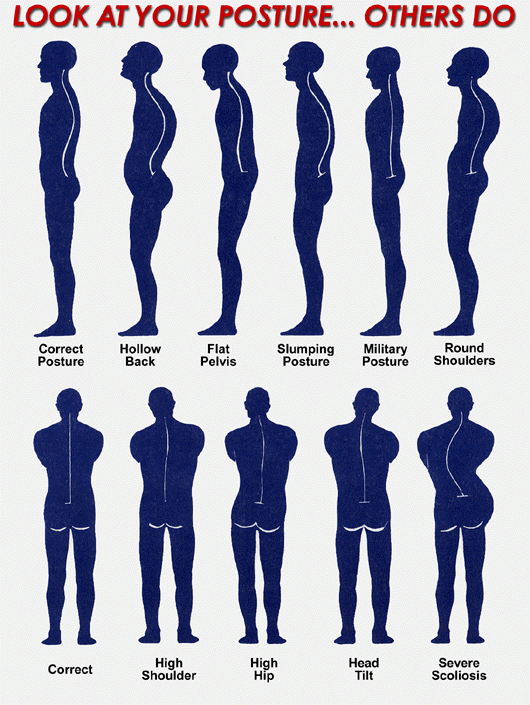
Take a look at how you sit - slumped middle, crossed legs, rounded shoulders, craning neck - all of which will create problems in the long term. And if your muscle tone is flabby, you will be relying on tendons and ligaments instead, running the risk of repetitive strain injury (RSI).

Make sure your desk, chair and screen - if you are working at a computer - are at the right height for you. Sit on an exercise ball rather than a chair to help engage your core abdominal muscles while you sit, and prevent you from slouching. Keep feet flat on the floor, hips and knees at right angles.

Exercise to keep those core muscles strong will also help. Pilates is excellent for this, but also other exercise like T'ai Chi and yoga will improve posture. Check in with the posture experts, Alexander Technique teachers, to help correct body mis-alignment and poor posture. If you work with any sort of personal trainer, they should also be eagled-eye about your posture to avoid injury when you exercise.

Freeing up your posture, alleviating the tension in the many muscle groups from shoulders to calves, will also improve blood circulation - which carries oxygen to the brain - keeping those neurons happily energised and your ability to concentrate enhanced.

Do this now and your body and brain will thank you when you're 80!